
Founders are using AI before they call counsel. Legal tech companies are building into areas shaped by old ethics rules. Law firms are trying to figure out which tasks should still be done by lawyers, which can be automated, and which should be handed off entirely.
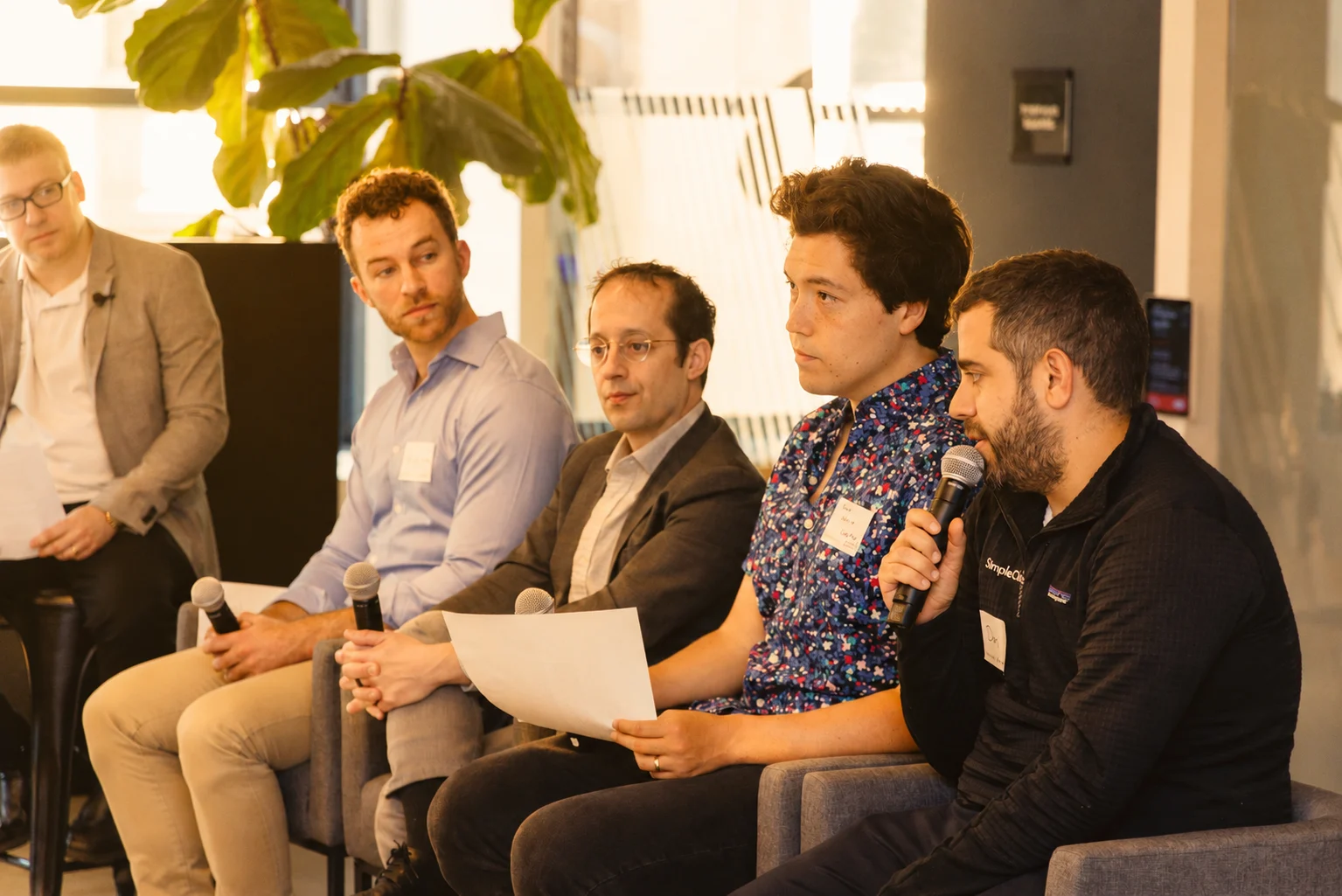
That was the throughline of SimpleClosure’s panel, “Law in the Age of AI.” The conversation was not really about whether AI will replace lawyers. It was more practical than that. AI is already changing the work around startup law: how founders ask questions, how legal tools get built, how firms think about workflow, and how quickly companies move from formation to wind-down.
For startup lawyers, the pressure is coming from a few directions at once.
Founders are showing up with AI-generated answers
Startup lawyers are used to founders trying to solve things on their own before calling counsel. Founders have always searched online, asked other founders, reused old documents, or tried to avoid legal spend until they had to.
AI changes the shape of that conversation.
A founder may now come to counsel with a polished answer from ChatGPT, a draft document, or a list of reasons the model gave them for why something should be fine. The answer may look organized and even be directionally useful, but it often depends on facts the model never had.
Jeff Laretto, a partner at Cooley, described the pattern from the law firm side. AI gives founders the ability to “find their own answers,” or at least think they have, and then send those answers to lawyers for proof checking. His reaction was blunt: “That’s almost always a disaster in practice.”
The problem is not that founders are curious. The problem is that the lawyer now has to debug the answer before giving advice. What did the founder ask? What facts did they leave out? Did the model assume the wrong jurisdiction, the wrong entity type, the wrong stage of the company, or the wrong legal issue entirely?
Jeff gave the example of a founder effectively saying: “You told me yes, but here’s the five things that ChatGPT told me that are contrary to what you said.”
The result is that counsel may spend the first part of the conversation correcting the premise before they can address the underlying legal issue.
The risk is bigger than bad citations
The most visible AI legal failures are the embarrassing ones: hallucinated cases, false citations, and filings that should have been checked before they ever reached a court.
Those examples are important, but startup lawyers are dealing with a less obvious version of the same problem. The AI answer may not be fake. It may be partly right while missing the detail that changes the analysis.
Jeff was clear about who is responsible when AI gets it wrong in a legal context: “It’s the firm, it’s the lawyer.”
That creates a supervision issue inside firms, not just a client issue. Junior lawyers may use AI to get an answer before they know enough to evaluate it. Jeff described young associates taking AI output and going “off on a tangent that is not the right tangent.”
This is where AI becomes tricky for law firms. It can remove some of the rote work that lawyers and paralegals used to handle manually, which may help clients avoid paying for hours of process work. But some of that rote work is also how junior lawyers learn what matters.
Jeff put it plainly: “There’s a cost that will come due. And that’s the training.”
Law firms may save time on the task and still have to answer a harder question later: how do junior lawyers build judgment if the early reps disappear?
Legal tech is running into old ethics rules
AI has also made it easier for founders to build products that sit uncomfortably close to legal advice.
Samuel Garcia, Partner at Amplo, talked about this from the perspective of legal ethics. He said he sometimes has to tell founders: “Have you considered that you’re offering straight up legal advice?”
“Have you considered that you’re offering straight up legal advice?
That may not be obvious to the founder. They may think they are building a chatbot, an intake tool, a document generator, or a workflow product. But if the tool applies legal rules to a user’s facts and tells them what to do, it may start looking like something else.
Samuel also pointed to fee splitting as a rule many founders do not know to think about. Most founders building AI products are not thinking about the ethics requirements lawyers all agree to uphold. They are thinking about product, speed, fundraising, and whether users want the thing they are building.
For startup lawyers advising AI companies, that creates a real role. It is not enough to review a disclaimer after the product is built. Counsel needs to understand the product flow. What does the tool ask? What does it generate? Is a lawyer reviewing anything? How are fees structured? How does the company describe the output to users?
The old rules may feel dated, but they still shape what can be built.
Law firms do not buy AI tools just because the demo is good
The panel also got into the gap between building legal tech and getting law firms to use it.
Jeff’s point was simple: if a company wants to sell into a large law firm, the first real conversation may not be with the lawyer who likes the product. It may be with the Chief Information Security Officer.
He said firms need answers to basic but serious questions: “What is your regulatory roadmap? What is your compliance framework? How do you wall off documents? How do you deal with export controls?”
“Firms need answers to basic but serious questions: “What is your regulatory roadmap? What is your compliance framework? How do you wall off documents? How do you deal with export controls?”
If a legal tech company cannot answer those questions, the demo does not matter much.
This is one of the reasons legal tech adoption can look slow from the outside. Lawyers can be resistant to change, but the procurement friction is not only personality. Firms have client confidentiality obligations, data security concerns, and internal risk standards that are not optional.
Even after a tool gets approved, there is another problem: lawyers actually have to use it. Jeff noted that selling into a law firm is not the same as getting adoption. Lawyers have habits, existing systems, and little patience for another platform unless it solves a problem they feel often enough.
A tool can clear procurement and still fail inside a firm if lawyers do not have a reason to open it during the workday. The products that last are usually the ones that remove a step lawyers already dislike, reduce a dependency they already feel, or fit into a workflow they already use. A flashy AI layer will not carry a product very far if using it creates another place to log in, another system to check, or another output someone has to clean up.
Workflow is becoming its own category
Dori Yona, Co-founder and CEO of SimpleClosure, drew a line that many companies need to consider: there is legal advice, and then there is the workflow around legal and regulatory processes.
He described SimpleClosure’s position directly: “We are not a law firm, we are not accounting firm, we are not providing legal advice.”
That matters because a lot of startup legal work includes tasks that are important but not always judgment-heavy. Documents need to be created. Filings need to be submitted. State responses need to be tracked. Payments need to be made. Investors may need visibility. Someone has to make sure the process does not stall.
Dori described SimpleClosure as building workflows around dissolution paperwork, franchise tax, state filings, document creation, state submissions, state responses, and payments.
For law firms, this is not necessarily bad news. Jeff made that point from the Cooley side. Some process-heavy work has low perceived value for clients and is not the kind of work a law firm wants to own manually. If that work can go to a specialized provider, the client may get a better experience and the lawyer can focus on the parts that actually need legal judgment.
The question is now whether a task belongs with a lawyer, with software, with a specialized workflow provider, or with some mix of the three.
AI is speeding up the company lifecycle
The panel was not only about legal work inside law firms. It also touched on what AI is doing to the startup lifecycle itself.
Jesse Carey, Product Strategy at Stripe, said Stripe Atlas is seeing an increase in company formation, including solo-founded C-Corps. He also said more founders are finding their first customer faster than before.
That is the optimistic side of AI: it is easier to research a market, build a prototype, launch something, and test demand without a large team.
Dori brought in the other side of that same cycle. More companies are forming, but more companies are also shutting down. He talked about older SaaS companies struggling to raise if they are not AI-first, and AI wrapper companies having trouble once foundation models start releasing similar features directly.
That has practical consequences for startup lawyers. A founder may shut down one company and start another faster than they would have a few years ago. Dori described founders shutting down and then raising for an AI version of what they had been building.
The legal cleanup still has to happen. The entity still exists. Investors still need to know what happened. Assets, IP, taxes, filings, liquidation preferences, and remaining obligations do not disappear because the founder has moved on to the next idea.
Dori also pointed out that a clean shutdown can affect the founder’s next company. When founders handle the process transparently, investors may appreciate it and sometimes become the first check into the next company.
That is the part startup lawyers should not miss. AI may make starting easier, but it does not make the rest of the lifecycle disappear. If anything, it makes lifecycle work more common: formation, financing, pivoting, wind-down, and restart.
What startup lawyers should take from this
AI is changing startup law in several places at once.
It is changing how founders show up to legal conversations. It is changing how junior lawyers work. It is pushing legal tech companies into ethics questions earlier than they may expect. It is making law firms rethink procurement, data security, and adoption. It is also making the startup lifecycle move faster, with more companies forming, testing, shutting down, and restarting.
For lawyers, the practical question is not whether to use AI or avoid it. The question is where legal judgment is actually needed.
Some work still belongs with counsel: risk assessment, investor dynamics, fiduciary questions, ethics, supervision, negotiation, and the moments when a founder is asking the wrong question.
Some work needs a better workflow, especially process-heavy parts of the lifecycle like company wind-down, where the work can be tedious, fragmented, and easy to leave half-finished.
Startup lawyers do not need to own every filing, notice, signature, and state follow-up by hand. They do need to know when those things matter, when the facts are unusual, and when a founder needs actual advice instead of another AI-generated answer.
AI may make parts of startup law move faster, but it also creates new points where lawyers have to slow down and check the work. Founders may arrive with AI-generated answers that leave out key facts. Junior lawyers may rely on tools before they have enough context to evaluate the output. Legal tech companies may build into ethics rules they have not fully considered. For startup lawyers, the question is not only which tools to adopt, but which parts of the client relationship still require their judgment, supervision, and understanding of the underlying facts.