
You’ve missed another sales target. There’s a reasonable explanation, just as there was last quarter. You still believe in what you’re building, but you’re starting to wonder how long to give it.
Knowing when to pivot a startup means looking closely at what customers do. If they’re paying and coming back, you may have something worth continuing. If they need help but won’t buy your current offering, there may be a different approach to test. When repeated attempts produce little demand and you’re running out of viable options, it may be time to consider closing.
Those situations can feel very similar when you’re inside the company.
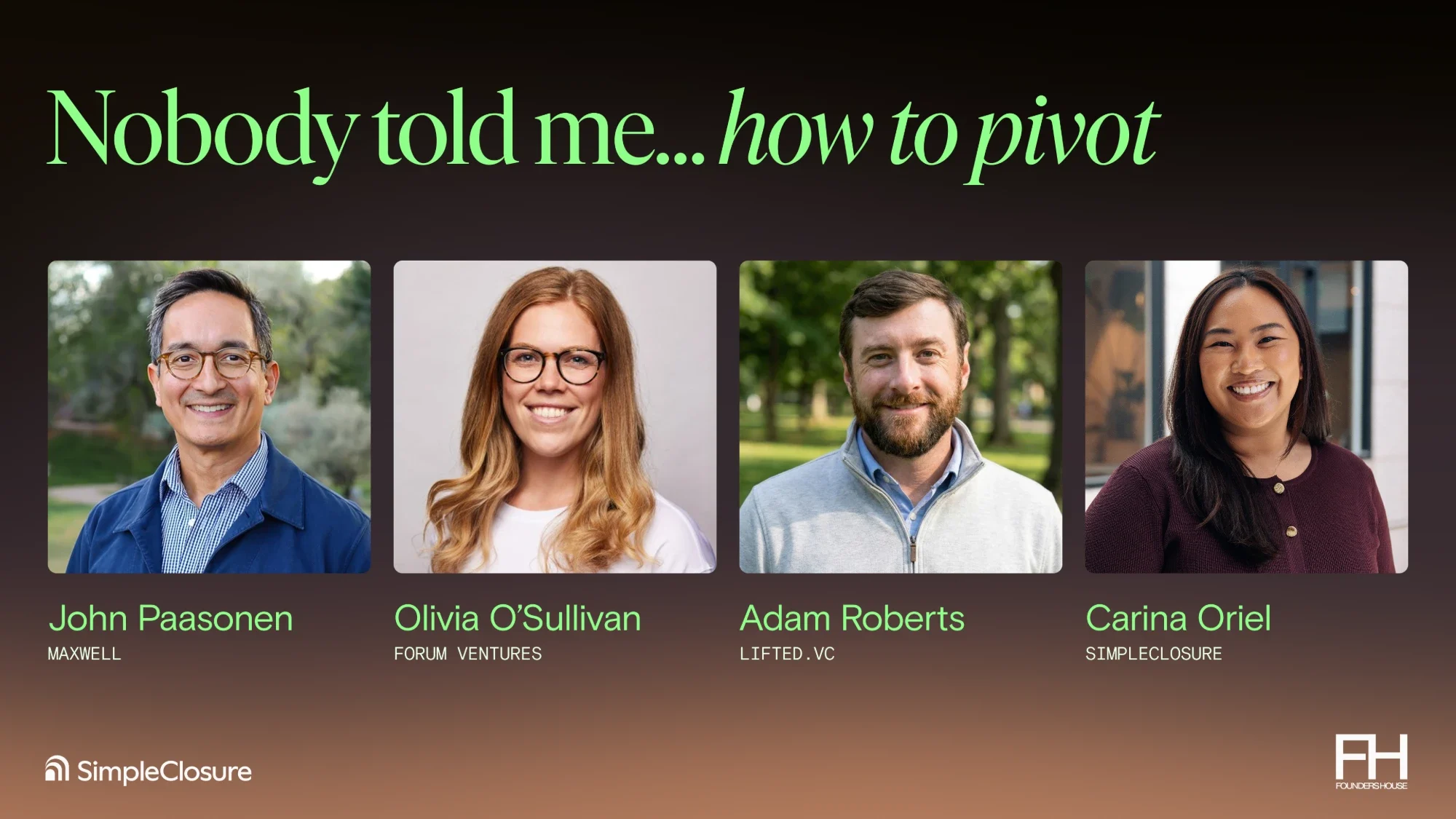
In SimpleClosure and Founders House’s “Nobody Told Me… How to Pivot” webinar, John Paasonen of Maxwell, Olivia O’Sullivan of Forum Ventures, and founder coach Adam Roberts discussed how to evaluate those signals. They talked through the signals they’ve seen founders miss and the decisions they’ve had to make themselves.
How do you know when it’s time to pivot your startup?
It may be time to pivot when the gap between your expectations and customer behavior keeps growing, even after you’ve tested reasonable explanations and changes.
John described launching three business lines at Maxwell and eventually closing two. Along the way, missed targets came with plausible explanations: a salesperson started late, enterprise contracts took time, or the market was soft.
Any one explanation could be true. Over several quarters, however, the distance grew between his enthusiasm for the business and what customers were doing.
It’s worth asking yourself: if every missed milestone has an explanation, what would it take for you to decide the approach needs to change?
What customer signals should you look for?
Look for commitments that match your company’s stage: customer conversations early on, then paid pilots, regular usage, retention, and expansion.
Olivia emphasized that evidence develops as a business matures. Getting the right people on the phone can be meaningful during discovery. Later, you need to understand whether those people will pay, use the product, and keep using it.
Adam pointed out that early demand can be easy to overlook when so much else is going badly. One customer who urgently needs the product and is willing to pay is worth understanding. Find out why it matters to them, then see whether other customers share that need.
Should you pivot or keep pushing through?
Continuing makes sense when customers are responding and you can explain what needs to improve. If what you’re learning keeps pointing toward a different customer, product, or business model, explore a pivot.
John suggested looking at what prospects are doing instead. If they’re buying from competitors, there’s demand to investigate. If nobody is buying, you need to understand whether the problem is urgent enough to spend money on.
Does slower growth mean your product has failed?
Slower growth can reflect a change in customer priorities or market conditions. Investigate those changes before abandoning the product.
John described Maxwell operating through a difficult mortgage market after years of growth. Customers still needed technology, but their problems and purchasing priorities had changed. Maxwell reassessed its products, customer segments, and go-to-market approach.
A separate audience scenario involved a founder trying to replace entrenched systems in a legacy industry. John recommended focusing on the smaller audit offering first: solve an immediate problem, earn trust, and learn where customers want more help.
For that founder, a customer paying for an audit would tell them more than another conversation about how the industry needs to change.

A decision guide based on the panel discussion.
How much runway do you need to pivot?
A pivot needs enough runway to test the new direction and decide what to do with the results. If you’ll also need to raise money, build that time into your plan.
Runway is how long your available cash can support the business at its current spending rate. A pivot changes that calculation if it requires development, a different sales cycle, or new expertise.
Adam cautioned that founders often underestimate fundraising timelines. Olivia encouraged founders to involve existing investors as soon as they begin seeing problems.
Before committing, write down:
What you need to learn.
The smallest test that could answer it.
What that test will cost and how long it will take.
What result would justify further investment.
What you will do if the result disappoints.
For example, imagine your new customer segment needs a three-month pilot before purchasing. With four months of runway, you’d have little time to absorb a delay or respond if the pilot falls short. You’d need to address that gap before committing to the pivot.
What are the signs it may be time to shut down your startup?
It may be time to shut down when you’ve repeatedly tested the idea without getting customers to commit, and you can’t identify a promising next attempt that the company can afford.
The panel discussed a founder who had pivoted early but still had no signed deals or revenue more than two years later.
Based on the information shared, Olivia would stop pursuing the current product. John agreed that he would stop investing in the software.
They also considered a consulting business. That option depended on whether customers would actually pay for the service. Changing the business model still requires testing demand.
After two years of work, stopping would be painful. But before spending another six months, the founder needed a reason to expect a different result.
For a closer look at the warning signs, read our guide to when it may be time to close your startup.
Does founder burnout mean you should close the business?
Being exhausted doesn’t tell you whether customers want your product. It does affect whether you want to keep running the company, and that deserves its own conversation.
One audience scenario involved a two-person business with paying customers, limited runway, and an exhausted founder.
John saw evidence worth building on. He encouraged the founder to focus on customers resembling those already buying and explore ways to extend runway.
Olivia also made room for a different answer: a founder may recognize the opportunity and still decide they no longer want to run the company.
You might need support, a different role, or a change in how the company operates. You might also decide you don’t want to continue. Having paying customers doesn’t make that conversation off-limits.
Could an acquisition or asset sale offer another path?
An acquisition, acquihire, or asset sale can be worth exploring if there’s a potential buyer and enough time to work through a deal. Start those conversations while you still have other options.
The panel cautioned against treating an acquisition as a last-minute rescue plan. Finding buyers, building relationships, and completing a process can take longer than founders expect.
These options also mean different things. An acquihire may center on the team. An asset sale may involve selected technology or other assets. Neither necessarily resolves everything involved in closing the existing company.
A hoped-for buyer is a risky assumption to build your remaining runway around.
What should you do if you decide to wind down?
Start by understanding what the company owes, who needs to approve the closure, and what it will take to finish the work. Involve your legal and accounting advisers before making commitments or distributing remaining funds.
Olivia described how difficult it is to see founders spend down to zero after months of warning signs. By then, the pressure on the founder and everyone depending on the business can be much harder to manage.
As a starting point, identify:
Who needs to be involved in decisions and approvals.
What the company owes and what closure may cost.
How employees, customers, investors, and vendors will be informed.
Which contracts, accounts, registrations, and filings need attention.
Our business shutdown checklist covers the broader process. The steps and timing will depend on your company’s circumstances.
What questions should you answer before deciding?
Before deciding, get specific about what customers have shown you, what another attempt would require, and whether you want to make it. These questions draw on the panel’s discussion:
Ask yourself | Look for |
What are customers actually committing? | Payments, time, repeat usage, and renewals. |
What have we already tested? | Documented attempts and what each one taught you. |
What would change in a pivot? | A specific alternative supported by customer evidence. |
Can we afford to test it? | Time and cash for testing, decisions, and remaining obligations. |
Do we want to continue? | An honest view of founder capacity and motivation. |
You may still feel uncertain after answering them. Talk through what you don’t know with your co-founder, investors, or trusted advisers while there’s time to do something about it.
For the full conversation and the panel’s advice on real founder scenarios, watch Nobody Told Me… How to Pivot.
Get help planning your company’s shutdown
If you decide to close, SimpleClosure can help you work through the shutdown process, from dissolution filings and closing payroll tax accounts to handling the remaining administrative work. We help founders understand what needs to happen and manage the work so they can move forward with fewer loose ends.